The Pay Transparency Directive: A complete guide for Polish employers. How to implement pay transparency in 2026 without paralyzing your company?
Most Polish boards and HR directors are making the same fundamental mistake today. They treat the EU pay transparency regulations as just another tedious bureaucratic obligation. Something like health and safety or GDPR – sign it, file it away, and forget about it.
This is a dead end. The EU Pay Transparency Directive drastically changes the rules of the game in the labor market. Gone are the days when a recruiter could casually ask during an interview: "How much would you like to earn?", while simultaneously concealing the budget allocated for the position. The introduction of the pay transparency directive in Poland forces companies to completely overhaul motivation systems, pay scales, and even... employee benefits strategies.
If your company employs more than 50 people, the time for improvisation is over. Either you prepare your organization for upcoming audits, or you risk massive penalties, losing top talent, and a reputational crisis. This guide will walk you through the transformation process step by step. No corporate jargon. Just facts, hard data, and ready-to-implement solutions.
What is the Pay Transparency Directive? A New Legal Reality
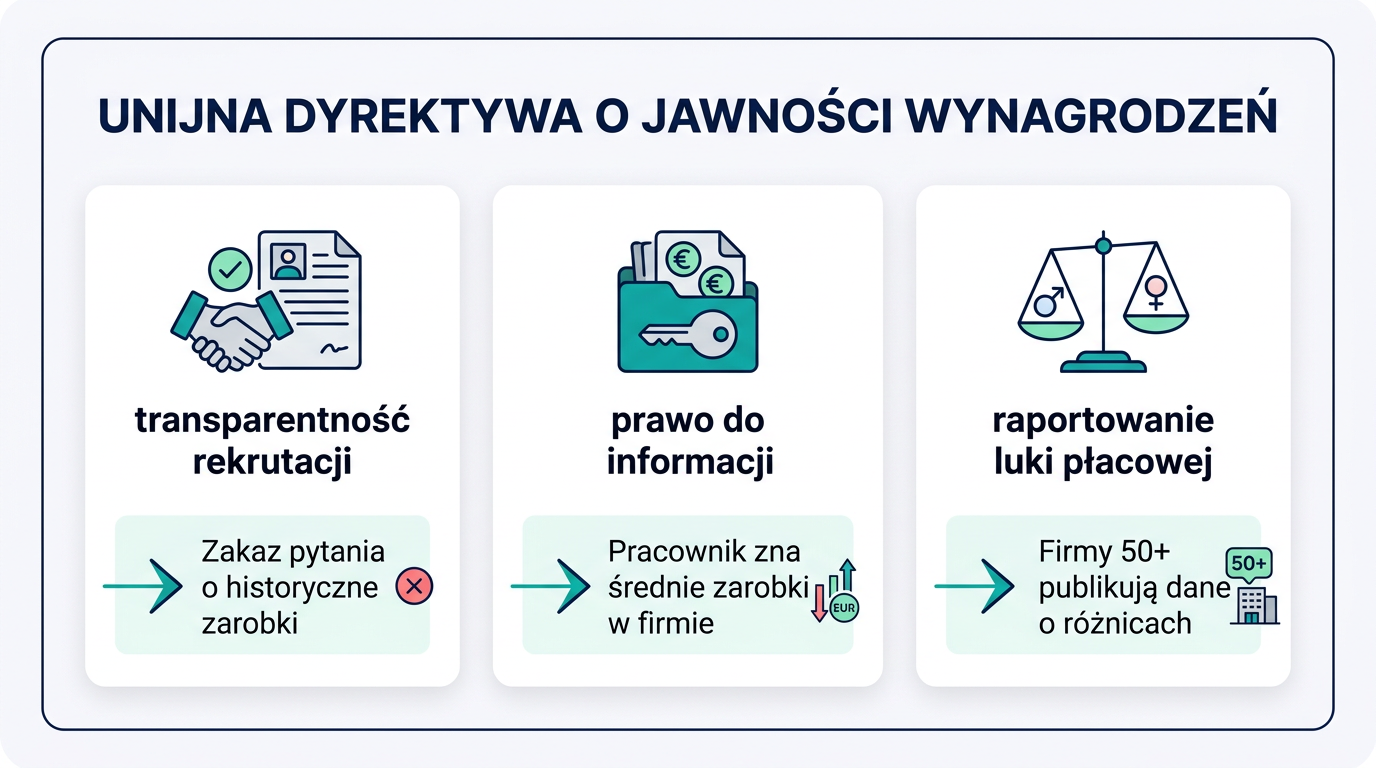
The Pay Transparency Directive (EU Directive 2023/970) is an EU legal act obliging employers in Europe to ensure pay transparency, eliminate the gender pay gap, and grant employees the right to information about earnings for similar positions.
Most managers believe they still have time, as member states have until June 7, 2026, to transpose the regulations. This is an illusion. The draft Polish law implementing the EU directive is already in an advanced stage, and the labor market began reacting much earlier. Candidates are already expecting transparency. Those who wait until the last minute to implement it have already lost the battle for talent.
Market Context: Why is the EU legislator losing patience?
According to official Eurostat data, the adjusted gender pay gap in the European Union still hovers around 13%. In Poland, depending on the sector (especially in IT, finance, and professional services), the actual difference in earnings between women and men in the same positions often exceeds 15-20%.
Pay Transparency 2026 is not an ideological project. It's a hard economic mechanism. Brussels has recognized that information asymmetry between employer and employee hinders healthy competition.
Real-life Example: A Costly "Secret" in a Manufacturing Company
For years, a certain FMCG company near Warsaw had an absolute ban on discussing salaries. The "company secret" clause in contracts was sacrosanct. As a result, two Senior Logistics Specialists - performing exactly the same tasks, with identical tenure - earned, respectively: PLN 6,500 gross (hired in 2022) and PLN 9,800 gross (hired during an urgent, rapid recruitment in 2025).
When the matter came to light (and employees always end up talking to each other), the company lost a loyal employee, and a review on GoWork destroyed their local employer branding for several months. New regulations mean that such a situation becomes not only unethical but, above all, illegal.
HR Tip
Stop immediately adding salary confidentiality clauses to new employment contracts and addenda. They are ineffective under the new law. Instead, prepare your management team for salary increase discussions based on meritocratic criteria, not on an employee's negotiation skills.
Salary Ranges in Job Postings: The End of the "Salary Commensurate with Experience" Era
Regulations oblige employers to provide the initial salary or objective salary ranges in job advertisements or before the job interview, without the possibility of asking candidates about their earnings at previous employers.
This is probably the most revolutionary change from the perspective of daily recruitment practice. The phrase "attractive salary" is becoming a thing of the past. When publishing an offer, you must clearly define the budget.
Table: What the directive allows and prohibits in the recruitment process
You can read more about the transformation of recruitment processes in Nais's expert article: What pay transparency changes in employer branding and candidate experience.
How to prepare recruiters? (Tools)
It is essential to implement Applicant Tracking Systems (ATS) that enforce the assignment of specific, finance-approved salary ranges to each recruitment template. A recruiter cannot publish an advertisement without filling in this field. Tools like Traffit or GreenHouse are already introducing features that facilitate managing pay transparency.
Gender Pay Gap Reporting: How to calculate the gender pay gap and avoid penalties?
Gender pay gap reporting is a statutory obligation to regularly publish data on differences in average remuneration between women and men in an organization, grouped by job levels and work of equal value.
If your report shows that the difference in earnings between women and men in the same positions exceeds 5%, and you cannot justify it with objective, gender-neutral criteria (e.g., length of service, performance, qualifications), you have a serious problem. The law will compel you to conduct a so-called joint remuneration assessment in cooperation with employee representatives (trade unions or a works council).
Calculation Methodology: How to approach the topic mathematically?
It's not enough to throw all employees into one Excel sheet and calculate an average. You must divide the organization into categories of employees performing "work of equal value."
The simplified diagram below illustrates the process of categorization and pay analysis:
A simple percentage formula is used to calculate the raw gender pay gap (GPG):
GPG = ((Average male salary - Average female salary) / Average male salary) * 100%
Remember, the devil is in the details: the basis for calculation is total compensation, including bonuses, awards, and benefits.
Reporting Deadlines for Polish Companies
Employers with over 250 employees will have to report this data annually. Smaller entities (150-250 employees, and eventually 100-150) will report every three years. However, smart organizations are already conducting internal simulations (so-called "shadow reporting") in 2026 to detect anomalies before the data sees the light of day.
Benefits and pay transparency: Are non-wage benefits included in compensation?
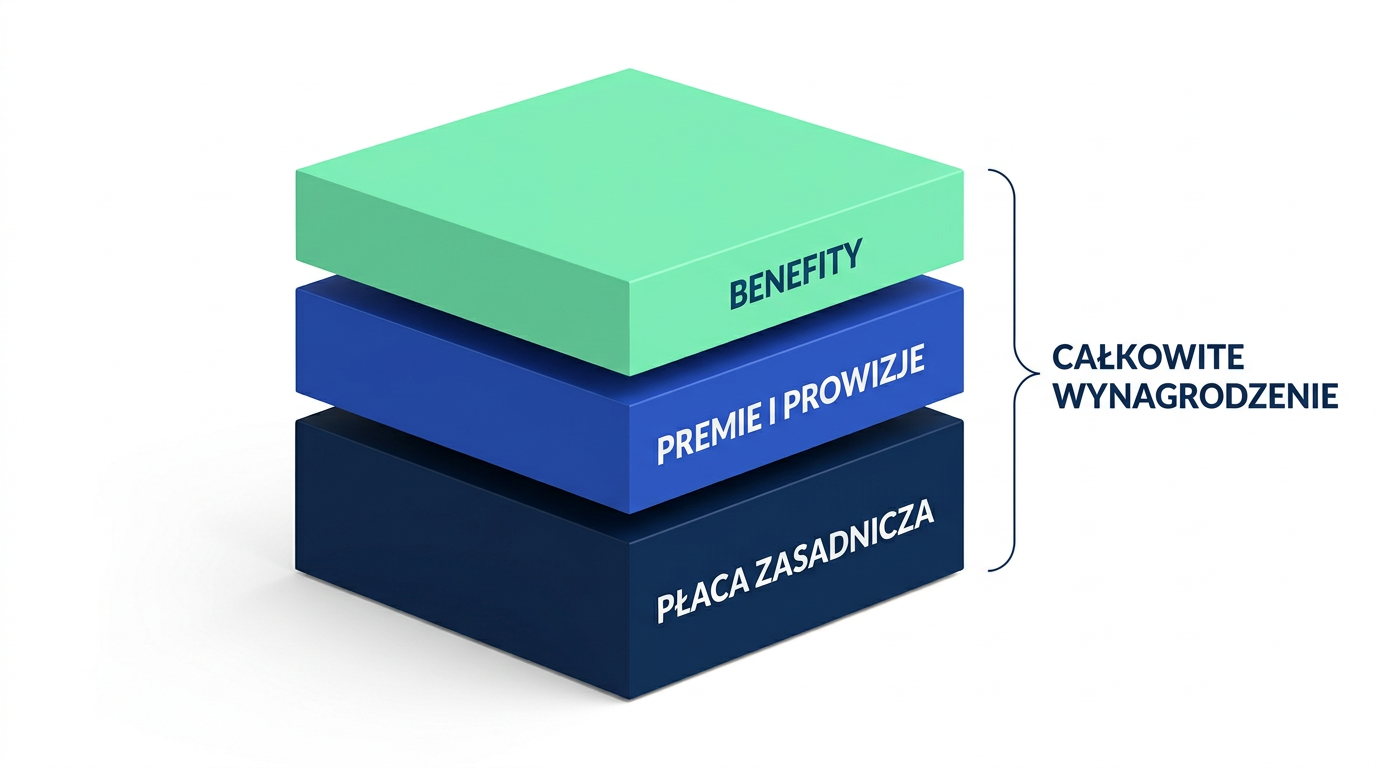
Yes, under the EU directive, the concept of "remuneration" includes not only basic pay but also all other benefits, including direct or indirect benefits in cash or in kind (e.g., company cars, medical care, cafeteria plans).
This is where the biggest implementation pitfall lies, as legal advisors point out. Many companies in Poland treat benefits as a tool for 'topping up' value for selected employees under the table, outside the official pay scale. "I can't give you a basic pay raise, but I'll add a car budget and a higher medical plan for your family." - sound familiar? From this moment on, such actions become a ticking time bomb.
Why can benefits skew your pay gap report?
If your organization's benefits system is not transparent and based on clear algorithms, it can unknowingly deepen pay discrimination. Statistics show that benefits with high capital value (e.g., a full budget for a company car for private use) are more often utilized by men in managerial positions, while women more often choose benefits related to flexibility or childcare, which are valued lower in a spreadsheet.
Tool: Modern cafeteria plan as a protective shield
The simplest way to structure non-wage benefits is to implement a transparent cafeteria system. Each position within the company structure is assigned a specific number of benefit points per month. The rules are clear: a Senior Developer receives X points, a Junior Developer receives Y points. We discuss how to effectively link non-wage benefits with new legal requirements in the article: Benefits and pay transparency: are non-wage benefits included in compensation.
Pay Audit in Practice: Step-by-Step Implementation Protocol
Don't panic. Implementing the principles of pay transparency directive w Polsce can be carried out without paralyzing current business operations. The key is a methodical approach. Here's a proven approach I use with my clients:
Step 1: Job Evaluation
You need to create a unified competency matrix. Forget about flowery job titles like "Marketing Ninja." Map out the tasks. Define what skills, responsibilities, and effort are required at each level. Each position must be assigned a point value.
Step 2: Data cleansing in HRIS
Collect all compensation components from HR and payroll systems (ERP/HRIS). Include:
- Base salary from employment contract / B2B contract (note: B2B contracts are also subject to analysis if the individual performs work personally and continuously for a single entity!).
- Statutory and discretionary bonuses.
- Monetary equivalent of benefits.
Step 3: Statistical analysis
Run the analytical spreadsheet. Group employees by level (grading) and gender. Calculate the pay gap. Identify so-called "outliers" – individuals earning significantly less or significantly more than the group average.
Step 4: Creating a corrective action plan
If the gap exceeds 5%, you are obligated to equalize it. This process usually spans 2-3 budget cycles (so-called compensatory top-ups during annual salary reviews). Attempting to equalize everything in one month could cripple the company's financial liquidity.
A detailed guide to risk mapping and building a culture of trust can be found here: Pay Transparency: How to Prepare Your Company for New Regulations and Build Trust.
The Biggest Mistakes Polish Companies Make When Implementing Pay Transparency
Most organizations stumble on the same issues. This stems from ingrained managerial habits from the 90s and the mistaken belief that "it will somehow work out."
- Explaining the gap with "sympathy" or "engagement": Managers often say: "Krzysztof earns more because he has a better attitude". In light of the directive, "attitude" is not an objective criterion. If Krzysztof achieves the same KPIs as Anna, their pay must be comparable. Differentiating criteria must be measurable (e.g., documented knowledge of a rare programming language used in the project).
- Implementing transparency without educating leaders: If you simply publish salary ranges, a queue of frustrated employees will form outside team leaders' offices asking: "Why does X earn more than me?". Line managers must be trained on how to justify an employee's position within the salary range based on a competency matrix.
- Ignoring B2B contractors: Polish companies are massively resorting to self-employment, thinking they can bypass labor laws. EU definitions of an employee are evolving. If your B2B contractor has a dedicated email address, specific working hours, and de facto reports to a managerial structure, auditors will include them in the pay gap calculation.
FAQ: Key questions about pay transparency 2026
Will an employee be able to check how much their colleague at the next desk earns exactly?
No. The directive does not introduce absolute named transparency (Scandinavian style). An employee has the right to request information about the average pay level, broken down by gender, for categories of employees performing the same work or work of equal value. They won't find out how much "Kowalski" earns, but they will learn the average and median for their position.
What are the consequences for a company for failing to comply with pay transparency regulations?
Sanctions will be severe. In addition to financial penalties imposed by the National Labor Inspectorate (which, according to the directive, must be "effective, proportionate, and dissuasive"), employees gain an easier path to claiming compensation before a labor court. Crucially: there is a reversal of the burden of proof. It will be the employer who, in court, will have to prove that they did not discriminate against the employee, rather than the employee having to prove the company's fault.
Can we differentiate salaries based on location (e.g., remote work from a smaller city)?
Yes, provided that this criterion is clearly described in the compensation policy and applied consistently to all (e.g., a relocation allowance or a market adjustment based on official cost of living). However, it cannot be a discretionary decision made ad hoc during recruitment.
How does the directive affect commission systems in sales?
Commission systems (variable pay) must also be transparent. The rules for calculating bonuses, sales thresholds, and commission values must be based on clear, non-discriminatory algorithms, to which all employees covered by the scheme have access.
Summary for HR and Boards
- It's not a question of "if," but "how soon": The Pay Transparency Directive drastically transforms the employer market into a transparent one. Implementing these changes takes time – the optimal process for mapping and refining pay scales takes 6 to 12 months.
- Salary ranges are the standard, not a benefit: Publishing salary rates in job advertisements is becoming a legal norm. Companies that do this first will gain a significant reputational advantage (Candidate Experience).
- A benefits cafeteria structures benefits: To avoid distortions in pay gap reports caused by discretionary non-wage benefits, it is necessary to structure the benefits system using modern points-based platforms.
- Managers hold the key: The success of the pay transparency transformation depends on leaders being prepared for open, mature communication about money with their teams.
Sources:
Directive (EU) 2023/970 of the European Parliament and of the Council of 10 May 2023 on strengthening the application of the principle of equal pay for equal work or work of equal value between men and women through pay transparency and enforcement mechanisms.
- Eurostat data (Gender Pay Gap Statistics, periodic reports 2024-2025).
- Labor market analyses and case studies of Nais cafeteria system implementations (2025/2026).